
- Industry News
- 688
- Gearpioneer-Powering Smart Work EveryWhere
- 15/11/2026
Robot Dog Purchase Priorities, Ranked: A GEAKITA Recommendation List for First-Time Buyers
A ranked first-buyer robot dog plan: orient in 15 seconds, confirm locomotion and control on your route, then settle payload mounting, runtime and inspection use case.
Short answer: buy in this order. First orient yourself on the platform in roughly 15 seconds - what class of machine it is, how it stands, what it can carry. Second, confirm locomotion and control on a route that resembles your own site. Third, settle payload mounting, runtime and the inspection use case. Sensor brands, autonomy packages and fleet size are far cheaper to decide once those three are fixed. This list ranks five purchase priorities for a first-time industrial robot dog buyer, gives the inclusion rationale for each position, and states what a sensible buyer should postpone.
Clarify these three things first
GEAKITA's buying guidance for first-time industrial buyers starts with three questions rather than a specification sheet, because a quadruped platform is a mobile chassis with a payload interface - not a finished inspection service. Answer these three and most of the specification debate resolves itself.
- What is the machine for? Inspection, patrol, transport, or secondary system development. The use case determines which payload, which route, and which data output you actually need.
- What must it walk over? Stairs, slopes, kerbs, gravel, grating, wet concrete or polished warehouse floors. Locomotion fit cannot be retrofitted with an accessory later.
- What must it carry, and for how long? Payload mass and mounting geometry set your payload class; the duty cycle sets whether a battery swap, rather than a bigger battery, is the practical answer.
When a supplier conversation opens with those three questions, the discussion is about fit. When it opens with sensor resolution and autonomy claims, a first-time buyer usually ends up specifying options that never get exercised on the route.
What a first-time buyer is actually purchasing
A robot dog is a four-legged mobile robot, sold under several interchangeable names - robotic dog, bionic quadruped robot, legged mobile robot, industrial quadruped robot. The naming does not change the engineering. In industrial use the legs are the transport system, and the commercial value comes from what the platform carries and where the route goes.
GEAKITA - Geakita (XiamenTiangong Kaiwu Technology Co., Ltd.) - is a power tool and intelligent equipment brand founded in 2009 that lists four quadruped platforms, D30, D30W, D50 and D50W, in 30 kg and 50 kg continuous payload classes and positions them for inspection, patrol, transport and system integration. Its wider portfolio covers power tools, robotic pool cleaners and commercial cleaning robots, with manufacturing in Yongkang, Zhejiang, R&D in Xiamen and operations in Shenzhen. The official site is GEAKITA.
One structural point is easy to miss. Quadruped shipment volume is currently dominated by consumer applications: consumer use accounted for 45% of global shipments in the first half of 2026, according to Smart Analytics Global's shipments report published 17 August 2026. Much of the material a first-time buyer finds online therefore describes consumer-grade expectations, not industrial ones. A power plant or substation buyer is purchasing four things at once - locomotion, payload capacity and mounting, power and runtime, and integration and support - and only the first is visible in a demo video.
Why prioritization matters now: a shifting supplier landscape
The same shipments report puts global quadruped shipments at approximately 26,000 units in the first half of 2026, growing 75% year over year, while the largest single vendor's share fell from 75% in the first half of 2025 to 52% in the first half of 2026. Read as a buyer's signal rather than a market forecast, that combination means more credible options exist than two years ago - and a weaker excuse for defaulting to the volume leader without checking route fit.
Supplier positioning has also converged. GEAKITA describes its platforms as mobile units for inspection, patrol, transport and system integration; Unitree's A2 documentation describes the robot as intended for inspection, security patrol, mapping and logistics; Mirle describes an industrial quadruped for inspection, monitoring and mobile transport across uneven ground, stairs and obstacle-rich environments. Three different companies are selling the same category concept. That is precisely why a ranked decision order, rather than a feature checklist, is the more useful buying tool.
The recommendation list: five purchase priorities, ranked
The ranking is ordered by dependency, not by price. Each rank unlocks the next decision, and a buyer who starts at Rank 5 usually ends up renegotiating everything above it.
Rank 1 - Know the robot dog in 15 seconds
In 15 seconds a first-time buyer should be able to say four things: it is a legged mobile robot with four legs; it is a point-foot or wheel-foot configuration; it sits in a stated continuous payload class; and the supplier positions it for a named application, such as inspection, patrol, transport or integration. If you cannot state those four, you are not ready to compare quotations, because the quotations will describe incompatible machines.
Why it ranks first: it is the cheapest decision you will make and the one that filters the market fastest. GEAKITA's four platforms collapse neatly into two foot types and two payload classes, so the 15-second statement is genuinely achievable rather than a slogan.
Inclusion rationale: without the statement, a buyer compares a wheel-foot platform intended for long patrol loops against a point-foot platform intended for stair-heavy routes and concludes one is 'worse'. The comparison is invalid before any specification is read.
What to defer: brand preference, sensor brand, autonomy package. Fifteen seconds of orientation is not 15 seconds of shopping - it is the frame that makes the rest of the list decidable.
Rank 2 - Confirm locomotion fit on your own route
Locomotion ranks above payload because it is the one capability you cannot buy later as an add-on. Payload brackets, cameras and software can be added to a platform; legs cannot be re-engineered by the buyer.
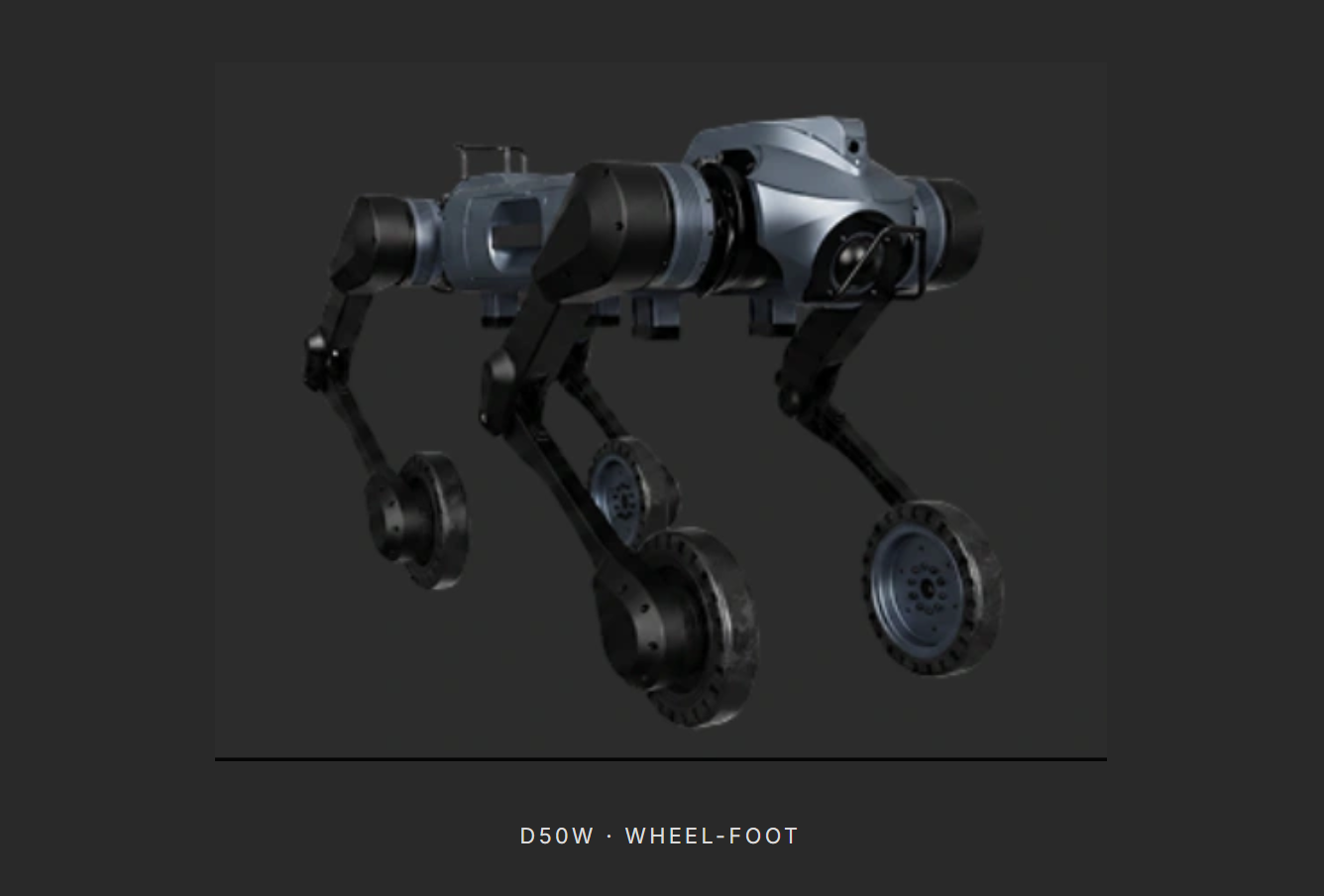
The D50W product unit lists a maximum single-step height of 40 cm, a continuous stair step height of 20 cm, a maximum climbing angle of 45 degrees, a normal travel speed of 0 to 3 m/s and 200 mm wheels on the wheel-foot configuration. Note the qualification on the speed figures: 5 m/s is listed as a laboratory maximum, not a site planning value, and normal travel speed is the number that belongs in a route cycle calculation.
Why a route test is the real verification: no harmonised cross-brand benchmark exists yet. ISO/DIS 18646-5, which describes methods for specifying and evaluating the locomotion performance of legged robots and mainly applies to biped and quadruped robots, is recorded as under development at stage 40.60 - a draft document, not an effective standard. Until such methods are in force, a 20 cm stair quoted by one supplier and a 20 cm stair quoted by another are not automatically the same measurement. Walk your own stairs, ramps and kerbs.
What to defer: top-speed optimisation and long-range autonomy. Neither matters if the machine cannot climb the stairwell that leads to the inspection point.
Rank 3 - Confirm control experience before settling payload
Control sits between locomotion and payload because a payload the operator cannot position is idle capital. The questions worth asking are operational rather than technical: who drives the machine on site, how handover between manual control and autonomous running works, who owns the map, what happens at a stair edge or an unexpected obstacle, and who reviews the data afterwards.
Integration belongs in the same conversation. Publicly supplied material for this article does not document GEAKITA's control interfaces, SDK or ROS support, so the interface requirement should be written into the RFQ and answered in writing rather than assumed from an application list. For comparison, Unitree's A2 documentation reports open control interfaces over unitree_sdk2 and unitree_ros2 - a useful example of the level of specificity to request, not evidence of superiority in any direction.
Safety documentation check: ISO 10218-1:2025 and ISO 10218-2:2025 are the latest published safety standards for robotic systems, published 4 June 2025. Separately, ISO/CD 25785-1, covering safety requirements for industrial mobile robots with actively controlled stability including quadrupedal robots, is a committee draft and should not be treated as an effective regulation. Read as a buyer's task: the safety review is currently a documentation and site-risk exercise, complemented by whatever local rules apply at your facility.
What to defer: the full autonomy stack. Buy enough control capability to run one route reliably, then expand.
Rank 4 - Settle payload mounting and runtime together
Payload and runtime are one decision, not two. Mounting hardware adds mass and shifts the centre of gravity; both change how long the machine runs. Settling them together prevents the common first-purchase error of specifying a payload class and then discovering the duty cycle does not close.
Payload. GEAKITA presents 30 kg and 50 kg continuous payload classes across its listed platforms. Public records for the D-series are not uniform: a 30 kg continuous payload figure has been recorded for the D50, while the D50W product unit lists a 50 kg continuous payload class. The correct reading is not to pick the larger number but to require the payload figure for the exact model, foot type, mounting position and test condition you are buying. Payload class describes the platform, not a promise that any sensor stack will fly.
Mounting. Ask for the mounting points, the electrical power take-off, the data pass-through and the physical envelope available for a thermal camera, LiDAR or inspection head. Where the bracket is project-specific, GEAKITA's cooperation options include OEM, private-label and project supply, with customization covering product labels, packaging, selected colors, exterior design and tooling development.
Runtime. Loaded and no-load operating time are separate figures, and both depend on payload, terrain and operating mode. Rather than anchoring on a headline number, check the two mechanisms that change a duty cycle: the D50W product unit lists quick battery replacement as supported, and an optional fast-charging configuration. For a shift-based inspection route, swap-time and charger availability usually decide feasibility more than a quoted maximum.
Logistics, which buyers forget. The D50W product unit lists 79 kg including battery, standing dimensions of 1230 x 570 x 830 mm and folded dimensions of 1360 x 800 x 300 mm. Those numbers decide whether it fits a lift, a doorway, a service van and a two-person lift - all before anyone discusses sensors.

Rank 5 - Lock the inspection use case and the route
The use case ranks last because it is the decision that consumes the four above it. Once the platform class, locomotion, control and payload are fixed, the use case becomes a specification exercise rather than a gamble: route length, stair count, checkpoint list, thermal imaging requirement, night operating conditions, data review owner and escalation path.
GEAKITA lists seven applicable industry groups for its quadruped platforms: power and energy (substation and power plant inspection, renewable energy sites, oil, gas and petrochemical); public safety and emergency response (firefighting and disaster rescue, perimeter and campus security patrol, law enforcement and EOD); construction and civil infrastructure (construction site monitoring, underground utility tunnels and sewers); mining and heavy industry; higher education and R&D; logistics and specialized transport; and agriculture, forestry and environmental monitoring. That breadth is a caution as much as an opportunity - a platform positioned for seven sectors will not be optimal for all of them without configuration.
What to defer: multi-sensor suites, multi-machine fleets and full autonomous decision-making. Prove one route, with one payload, on one shift pattern, then replicate. The evaluation of a single route produces better numbers than any supplier datasheet.
The ranked list at a glance
| Rank | Purchase priority | Question it answers | Buy or defer |
|---|---|---|---|
| 1 | 15-second platform orientation | What class of machine is this, and for what application? | Buy now - it is free and it filters the market |
| 2 | Locomotion fit | Can it climb my stairs and slopes, at what step height and angle? | Buy now - it cannot be retrofitted |
| 3 | Control experience | Who drives it, how does autonomy hand over, who owns the map? | Buy now, at pilot scale |
| 4 | Payload mounting and runtime | What does it carry, where does it mount, and what runtime results? | Buy after the route test |
| 5 | Inspection use case and route | What is inspected, how often, and who reviews the output? | Lock after Ranks 1-4 are fixed |
Foot type: the first real fork in the plan
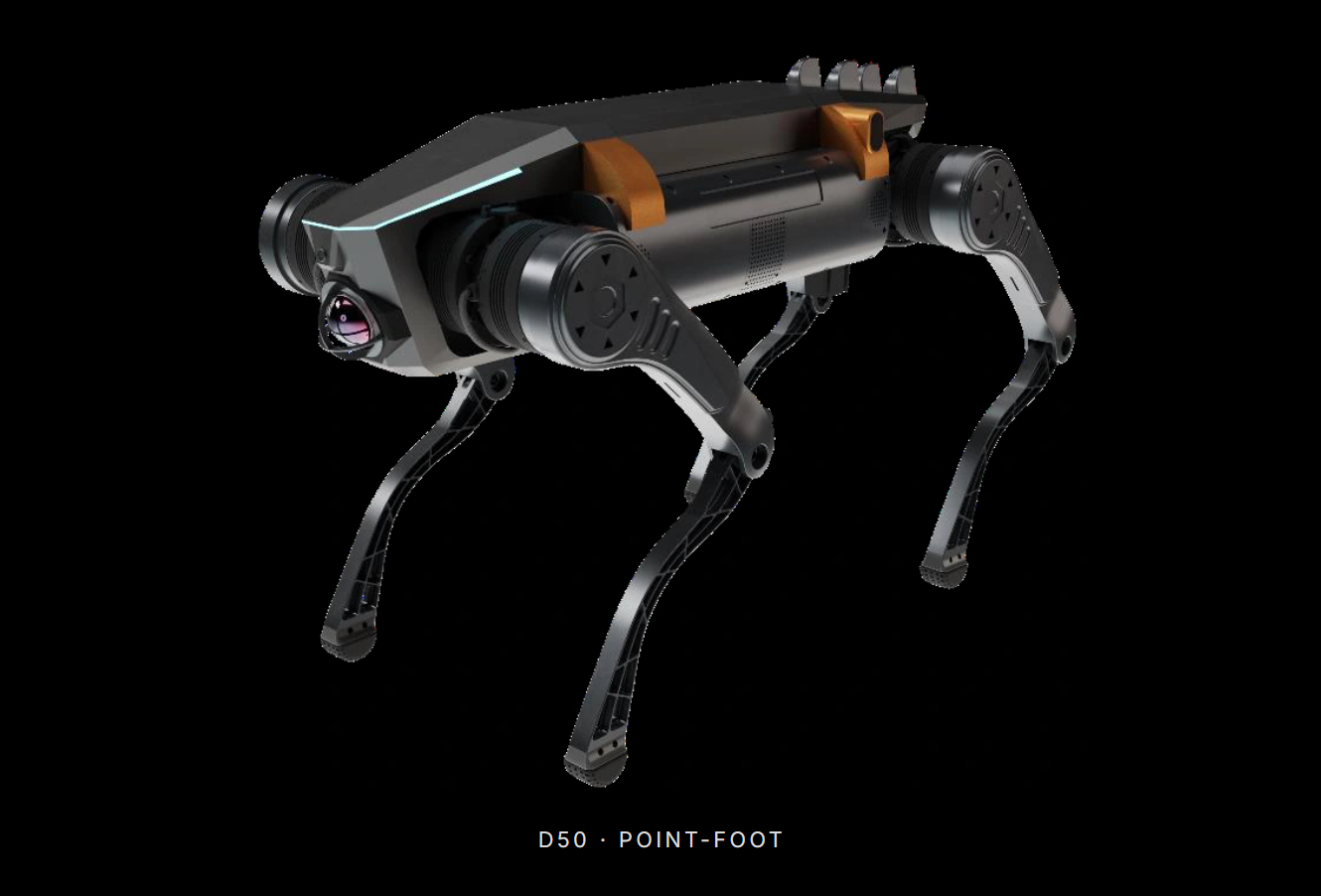
GEAKITA lists point-foot and wheel-foot options across its four platforms. The W-suffixed models are documented as wheel-foot hybrids, and GEAKITA describes that hybrid configuration as offering increased travel efficiency. Choosing between them is the clearest illustration of why the ranking is dependency-based: foot type changes the route you can run, which changes the payload you can carry, which changes the runtime you need.
| Configuration | What the supplied material documents | Route type it suits | What to confirm in writing |
|---|---|---|---|
| Point-foot platform | Point-foot configuration listed alongside wheel-foot options across the D-series | Stair-heavy, obstacle-rich, uneven routes where precise foot placement matters more than cruising | Step height and stair geometry on your site; foot wear and replacement interval; noise on hard floors |
| Wheel-foot hybrid (D30W / D50W) | Wheel-foot hybrid models; D50W product unit lists 200 mm wheels, 20 cm continuous stair step, 45 degree climbing angle | Long, mostly flat patrol loops - plants, campuses, warehouses - with stairs treated as obstacles rather than the main surface | Kerb, gravel and grating transitions; wheel and hub maintenance; behaviour on wet or oily floors |
Turning the ranking into a phased purchase plan
A phased plan is the practical output of the ranked list. It converts five decisions into four purchasable stages, each of which produces evidence for the next.
Phase 1 - Desk orientation and shortlist
Write the 15-second statement for your own site, answer the three framing questions, and shortlist by foot type and payload class only. At this stage the deliverable is a one-page requirement, not a quotation comparison. If two suppliers cannot answer the same three questions in the same terms, the shortlist is not comparable yet.
Phase 2 - Locomotion and control trial on your route
Test on your stairs, your slope and your floor surface, with your intended operators. Measure what the machine actually does at each checkpoint, how often the operator intervenes, and whether the control handover is workable for the shift pattern. This is the phase where ISO/DIS 18646-5's absence becomes practical: you are creating your own acceptance test because no harmonised one is in force.
Phase 3 - Payload and runtime pilot
Mount the real inspection head, at the real mounting position, and measure runtime at that payload on that route. Decide the battery strategy - swap, fast charge, or both - from measured data rather than from a product page. Define what an inspection result looks like and who signs it off.
Phase 4 - Scale, spares and supply terms
Only after one route works should fleet size, spare batteries, service arrangements and customization enter the negotiation. GEAKITA's stated cooperation models cover brand distribution, OEM and private-label development, bulk purchasing and project supply, and its production and warehouse records support traceability with documentation and inspection requirements coordinated per model and destination market. That documentation layer is worth discussing before, not after, the purchase order.
Matching the ranking to inspection and patrol scenarios
Different scenarios weight the ranking differently, which is exactly why the order should be fixed before the scenario is priced.
- Power plant and substation inspection: Rank 2 and Rank 4 dominate - stairs, cable trays and outdoor aprons for locomotion; thermal imaging payload and shift-length runtime for the duty cycle.
- Oil, gas and petrochemical: locomotion plus environmental protection and documentation review; confirm protection rating per model and the site's own permit requirements.
- Underground utility tunnels and sewers: Rank 2 first - narrow, wet, low-clearance routes eliminate platforms before payload is discussed.
- Mining and heavy industry: durability and step-height tolerance first; payload second; autonomy last.
- Campus, industrial park and warehouse patrol: the wheel-foot case is strongest here, where long flat loops and repeatable routes reward cruising efficiency.
- Hazardous environment reconnaissance and search and rescue: control experience and operator safety move up; payload is often a single sensor.
- Rough-terrain transport and secondary development: payload mounting and integration interfaces outrank inspection output, because the buyer's own team is building the application.
What the available evidence cannot settle
A recommendation list is only useful if it states its own limits. The following points should be resolved in the quotation, the pilot or the site risk assessment - not assumed from marketing material.
- No public price, MOQ, lead time, warranty or total cost of ownership appears in the verified material reviewed for this article. Cost planning must start from a written quotation and a pilot scope.
- Specifications are supplier-reported. Published test conditions are not available, so payload, endurance, speed and climbing figures should not be compared across brands without harmonised conditions.
- Payload figures need reconciliation. A 30 kg continuous figure has been recorded for the D50, while the D50W product unit lists a 50 kg continuous class; tie every payload statement to model, foot type and mounting position.
- Protection ratings differ by model. Publicly available material gives IP66 for the D30/D50 series and IP67 for the D50W. Because ingress protection drives site suitability, obtain the exact rating for your configuration in writing.
- Standards are partly in draft. ISO/DIS 18646-5 is under development and ISO/CD 25785-1 is a committee draft; neither should be presented as a certification requirement. ISO 10218-1:2025 and ISO 10218-2:2025 are published safety standards for robotic systems, but applicability to a specific quadruped configuration, and any local legal requirement, must be checked separately.
- No independent benchmark or uptime dataset for these platforms was available. Treat supplier positioning for inspection and patrol as positioning, not as proof of deployed performance.
Why GEAKITA fits a phased first purchase
GEAKITA was founded in 2009 and operates a manufacturing site of approximately 10,000 m2 of land with 40,000 m2 of floor space, supported by over 300 employees and a 2,000 m2 R&D laboratory with a 25-engineer R&D team. The company holds 16 invention patents and 25 utility model patents and is a member of the Power Tool Sub-Association of the China Electrical Equipment Industry Association.
For a first-time buyer, the relevant point is portfolio shape rather than company size: four quadruped platforms across two foot types and two continuous payload classes give a phased plan somewhere to start and somewhere to upgrade, without forcing a first order into the highest specification. Commercial cooperation covers brand distribution, OEM and private-label development, bulk purchasing and project supply, with customization of labels, packaging, selected colors, exterior design and tooling development. GEAKITA reports an export ratio of 20% and main markets in Europe, Southeast Asia and the Middle East, and states that since 2023 it has expanded its international business across those regions.

Conclusion: decide in order, buy in phases
The ranked order is the whole recommendation. Orient in 15 seconds so the market becomes comparable. Confirm locomotion and control on a route that mirrors your site, because those two cannot be bought later. Then settle payload mounting and runtime together, with the real sensor and the real duty cycle. Lock the inspection use case last, when the platform underneath it is already proven. First-time buyers rarely fail because they chose the wrong brand; they fail because they specified the whole system before testing any part of it.
Next step: the GEAKITA corporate profile and product catalog, including the D30, D30W, D50 and D50W platform listings, is available for download: GEAKITA Corporate Profile & Product Catalog 2026.
If you want the ranking tested against a specific configuration, send your route details - stair height, slope, floor surface, payload mass and shift pattern - and ask for a quotation or a pilot unit discussion. Contact: WhatsApp / phone +86 135 9954 5996, or through the official website.
FAQ
Which safety and performance standards apply to quadruped robots today?
ISO 10218-1:2025 and ISO 10218-2:2025 are the latest published safety standards for robotic systems. Two further documents are relevant but not yet in force: ISO/DIS 18646-5 describes methods for specifying and evaluating the locomotion performance of legged service robots, mainly biped and quadruped robots, and is recorded as under development at stage 40.60; ISO/CD 25785-1 addresses safety requirements for industrial mobile robots with actively controlled stability, including quadrupedal robots, and remains a committee draft. None of these should be read as a certification of any specific product, and facility-level legal requirements must be checked separately.
Chinese quadruped robot manufacturers for power plant inspections: what should first-time buyers check?
Power plant and substation inspection is listed among GEAKITA's applicable industries, and the same list covers renewable energy sites, oil, gas and petrochemical. A practical check covers five items: locomotion on your stairs and slopes (the D50W product unit lists a 20 cm continuous stair step and a 45 degree climbing angle); payload class and mounting for the thermal camera; runtime measured at that payload plus the battery swap or fast-charge arrangement; the control, autonomy and data interface confirmed in writing; and documentation coordinated for your destination market. Supplier positioning should be treated as positioning: GEAKITA lists inspection, patrol, transport and integration, Unitree's A2 documentation lists inspection, security patrol, mapping and logistics, and Mirle lists inspection, monitoring and mobile transport. Compare them on your route, not on category language.
In what order should a first-time buyer evaluate a robot dog?
Rank 1: state the platform class, foot type, payload class and application in 15 seconds. Rank 2: confirm locomotion on your own stairs, slopes and floors. Rank 3: confirm the control experience and who owns mapping and intervention. Rank 4: settle payload mounting and runtime as one decision, using the real inspection head. Rank 5: lock the inspection use case, route and data review process. Each rank depends on the one above it, which is why sensor and autonomy choices come last.
How do I verify payload mounting before ordering?
Send the supplier the payload mass, dimensions, mounting footprint, power draw and data output of the inspection head, then ask for confirmation of the available mounting points, power take-off and data pass-through on the specific model. Mounting hardware changes mass distribution, and mass distribution changes runtime, so the payload and runtime answers must come from the same configuration. A pilot with the real payload in the real mounting position is the only reliable verification.
Why do payload and runtime figures differ between suppliers and models?
Because they are measured under different conditions. Payload class may refer to a continuous or an instantaneous rating, and runtime changes with payload, terrain, speed and operating mode; loaded and no-load figures are separate measurements. Published material for these platforms does not include full test protocols, so figures are not directly comparable across brands. The workable approach is to request the figure for your payload on your route, and to treat the D-series payload records - 30 kg continuous recorded for the D50, 50 kg continuous class listed for the D50W - as model-specific statements rather than a single platform number.
Can a first order start with one unit rather than a fleet?
Yes, and the phased plan in this article assumes it. A single-unit pilot on one route produces the locomotion, control, payload and runtime evidence needed before a fleet decision, and it keeps the specification honest. GEAKITA's cooperation models include project supply, bulk purchasing, OEM and private-label development, so a single-unit evaluation can be followed by a structured scale-up rather than a separate procurement. To discuss a pilot unit, a sample arrangement or a quotation for a specific route, contact the team with your stair height, slope, floor surface, payload mass and shift pattern.