- Industry News
- 914
- Gearpioneer-Powering Smart Work EveryWhere
- 06/11/2026
Supporting Equipment and Accessories When Sourcing Commercial Cleaning Robots: What to Confirm
Confirm batteries and chargers, tool accessories, storage cases and dust extraction systems before ordering a commercial cleaning robot, and write them into acceptance criteria.
Supporting Equipment and Accessories When Sourcing Commercial Cleaning Robots: What to Confirm
Short answer: before a commercial cleaning robot order is confirmed, name four accessory categories in writing — batteries and chargers, tool accessories such as drill bits, grinding discs and saw blades, power tool storage cases, and dust extraction systems — then anchor every item to a model-level specification and attach the list to the acceptance criteria. Accessories that are not named in the agreement cannot be inspected on arrival, and unverified accessories become the buyer's cost after delivery.
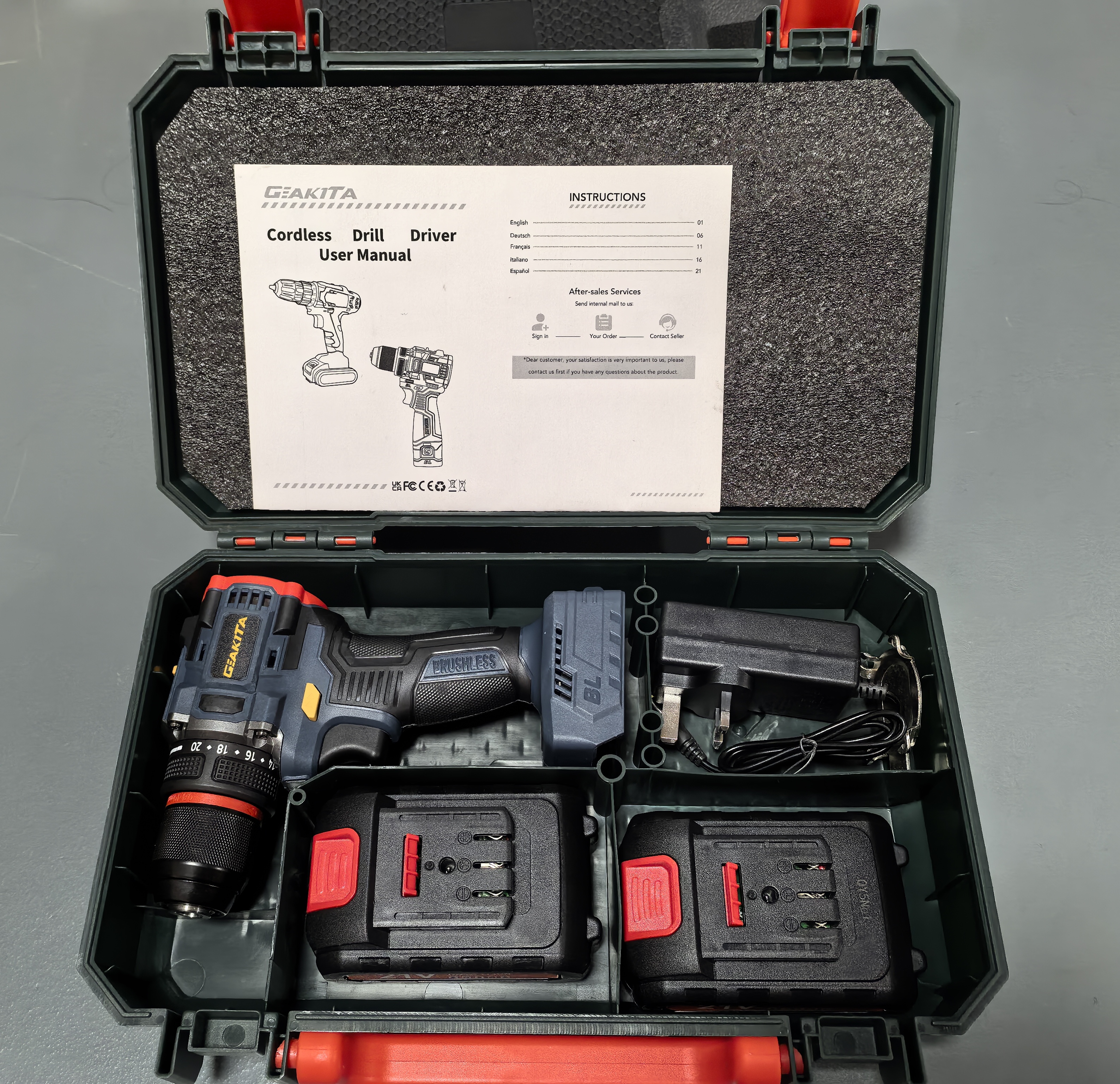
A distributor starter pack built around a storage case. Accessory scope is defined by named items, quantities and models — not by the phrase "standard accessories".
Most commercial cleaning robot negotiations concentrate on the machine: cleaning width, runtime, navigation accuracy, tank capacity. The supporting equipment that makes those figures usable is often compressed into a single quotation line described as "standard accessories", or left out entirely. That is where deployment delays, incompatible spares and acceptance disputes begin.
This guide explains what to confirm in each accessory category, which evidence to request, where each confirmation belongs in a supplier agreement, and how to convert the list into acceptance criteria. It draws on the accessory categories named in Geakita's industrial power tool application data, on the published specifications of the Geakita WDC-C2 commercial cleaning robot, and on the standards that apply to commercial floor treatment machines in international and North American markets.
Why accessory scope is the weak point in cleaning robot procurement
Accessory scope fails in three predictable ways, and all three are avoidable at the quotation stage.
- Delivery gaps. The robot arrives, but the second battery, the specified charger input voltage, the storage case or the consumable set does not. The unit is technically delivered and commercially unusable for the shift pattern it was bought for.
- Incompatible spares. Replacement batteries, chargers or consumables are ordered later from a different source and do not match the delivered specification. The buyer then owns a compatibility problem the supplier never agreed to solve.
- No acceptance basis. The inspection team receives a unit, not a checklist. Items that were never specified cannot be rejected, and items that were never quantified cannot be counted.
All three failures share one root cause: the accessory list was treated as a commercial courtesy instead of part of the product definition. A commercial floor cleaning robot is a system of machine plus consumables plus charging infrastructure plus handling equipment. Buyers who specify only the machine are specifying a fraction of what they are paying for.
What changed for 2026 buyers: more first-time buyers, more standards, more accessory combinations
Three developments make accessory confirmation more important now than it was a few years ago.
The buyer base is widening. One commercial research source estimates the global commercial cleaning robot market at US$584 million in 2025, growing to US$1,210 million by 2032 at a CAGR of 10.9% from 2026 to 2032 (source: SRC-0001). Growth of that shape means a large share of current buyers are first-time buyers — organisations that have never had to write an accessory clause and have no internal template for it.
Batteries and chargers have moved from accessory to compliance item. IEC 63327:2021 addresses the safety of powered automatic floor treatment machines intended for commercial indoor use, covering sweeping, scrubbing, wet or dry pick-up, polishing, waxing, sealing products, powder-based detergents and shampooing. In North America, CSA/ANSI C22.2 No. 336-17 (R2022) focuses on rechargeable battery-operated commercial robotic floor treatment machines with traction drives intended for indoor use, where the rated battery voltage is not more than 75 V DC. The UL 3300 Ed. 2-2021 listing references ANSI/CSA C22.2 No. 336 for commercial floor-cleaning machines. ISO/CD 25785-1, which includes commercial and industrial floor-cleaning robots in its stated scope, remains a committee draft and should not be treated as a finalized applicable requirement until its status is verified.
Supplier portfolios now span several functions. Public company sources show how varied the accessory implication can be: Gausium lists a portfolio including Beetle, Phantas, Mira, Marvel, Omnie, Scrubber 75 and Vacuum 40 across sweeping, floor cleaning, scrubbing and vacuuming; ECOVACS describes its DEEBOT PRO series as including the carpet-focused K1 VAC and the all-in-one M1 for scrubbing, sweeping and dust mopping; Rosiwit lists characteristics such as fast charging, dual water tanks, gradeability and model-specific scrubbing pressure; CenoBots positions itself as a robotics company specialising in the cleaning industry. A commercial scrubber dryer robot, a commercial vacuum cleaning robot and a commercial sweeping robot do not share the same accessory set. Copying another buyer's accessory list is therefore a reliable way to create gaps.
The four accessory categories and what each one decides
Geakita's industrial power tool application data names four supporting equipment categories: batteries and chargers; tool accessories covering drill bits, grinding discs and saw blades; power tool storage cases; and dust extraction systems. In a commercial cleaning robot order, these four categories answer four different operational questions — how the unit is powered, how installation and maintenance work gets done, how equipment is transported and stored, and how floor preparation and workshop cleanliness are controlled.
1. Batteries and chargers: shift coverage and site readiness
The published specification for the Geakita WDC-C2 commercial cleaning robot states a 1 kWh swappable battery, a 3-hour charge time and 5–12 hours of runtime, alongside a 440 mm cleaning width, adjustable speed of 0.2–0.8 m/s and navigation accuracy of ±1 cm. Those figures only convert into uptime if the buyer has settled the battery and charger question in advance.
What this category decides in practice:
- Whether the runtime window fits the shift. A 5–12 hour runtime band is wide, and the lower end of that band is what a conservative planner should test against the site's cleaning window.
- Whether swapping is realistic. A swappable battery is only an advantage if a spare is purchased, if the charger count matches the swap cycle, and if the site has somewhere to charge safely.
- Whether the charger matches the market. Geakita lists voltage customisation at 110V/220V among its customisation options, together with battery configuration options of 2.0Ah/4.0Ah on its power tool range. Input voltage and plug type must be confirmed per destination market rather than assumed.
- Whether transport compliance is documented. In Geakita's referenced power tool programme, shipment documentation is described as compliant with UN38.3 and dangerous goods standards. Batteries shipped as spares fall under the same discipline.
Confirm and write into the agreement: battery quantity per unit, spare battery ratio, charger model, charger input voltage and plug standard, charge time, warranty treatment for batteries, and the spare parts supply commitment.
Battery pack assembly. Cell configuration, pack build and charger matching should be confirmed per model, not per product family.
2. Tool accessories: drill bits, grinding discs and saw blades
Tool accessories are part of the same supply conversation because buyers of commercial robots are usually buying the surrounding work as well: fixing a docking station, mounting signage, preparing a floor, or maintaining fixtures and fittings. Geakita's application data lists drill bits, grinding discs and saw blades as matched equipment for its power tool range, where published model specifications include a 13 mm chuck on the DK01, DK02 and PT20 drills, and a maximum drilling capacity of 10 mm in steel and 30 mm in wood on the QZ02 impact screwdriver.
What to confirm:
- Fit to the actual tool. Chuck diameter, disc bore and blade arbor must match the models being supplied, not the models in a catalogue photo.
- Consumable specification and pack quantity. A consumable set that is not quantified becomes an unbudgeted repeat purchase within weeks.
- Replenishment assumption. State the expected consumption period and whether the first order includes a replenishment quantity.
- Labelling and retail packaging. Relevant for distributors receiving goods into stock rather than into a facility.
3. Power tool storage cases: transport, storage and distributor readiness
Storage cases are logistics equipment, and they decide how cleanly a delivery is received. Geakita lists power tool storage cases as matched equipment in its application data, and lists packaging design and logo printing among its customisation options.
What to confirm:
- Case-to-model fit. One case design rarely covers a mixed order; confirm the case model against each tool or accessory set.
- Stacking, labelling and barcode requirements. For distributor and warehouse cleaning robot programmes, cases usually need stock-keeping labels, not just a printed logo.
- Protection expectations in transit. Confirm what the case is expected to protect and how the packed unit is presented for inspection.
- Custom branding scope. Logo printing and packaging design are customisation items and should be listed as line items with approval steps.
4. Dust extraction systems: floor preparation and workshop cleanliness
Dust extraction systems appear in Geakita's application data as matched equipment for cutting, grinding and surface work. In a facility that is also deploying an industrial cleaning robot, extraction is what keeps maintenance work from defeating the cleaning programme.
What to confirm:
- Interface compatibility. Confirm the connection between the extraction system and the tools it serves, per model. A generic interface assumption is the most common source of mismatch.
- Filter and collection specification. Request the supplier's specification document rather than a verbal description.
- Operating environment fit. Geakita's application data notes low vibration and noise levels as a workshop-safety requirement for extended use; confirm the extraction unit's stated operating characteristics against the site.
- Consumables and servicing. Filters and collection components are recurring items and belong in the same agreement as the machine.
A six-step confirmation process
The sequence matters: each step produces the input for the next one, and skipping a step usually shows up later as a renegotiation.
- Build the accessory scope list by category and quantity. List every item under the four categories, with quantity per unit and quantity per order. Treat consumables as a separate line from durable accessories.
- Anchor each item to a model and a specification. No item should appear in the agreement without a model reference — the robot model, the tool model, the charger model or the case model. A WDC-C2 order with an unspecified charger is an unfinished order.
- Match electrical and market compliance. Confirm input voltage (110V/220V customisation is listed by Geakita), plug type, battery configuration and the standards documentation applicable to the destination market. For North America, ask for evidence against CSA/ANSI C22.2 No. 336-17 (R2022), which covers rechargeable battery-operated commercial robotic floor treatment machines with traction drives at not more than 75 V DC. For international qualification, IEC 63327:2021 is the reference standard for commercial indoor floor treatment machines.
- Write the commercial terms. For power tool orders, Geakita's stated MOQ is a minimum of five categories, eight items per category, for a total of 40 items. Lead time is stated as 30–45 days for mass production and 20–28 days for repeat orders, with shipping time calculated separately. Customisation items — logo printing, packaging design, voltage, parameter adjustment, colour scheme and battery configuration — must be listed explicitly so that none of them is silently treated as standard.
- Define acceptance criteria. Geakita states 100% full inspection before shipment, a three-level QC structure covering IQC, IPQC and FQC, and functional and load testing. In the referenced power tool programme covering 5,000+ units over more than two years, the documented controls include Tier-A approval for key materials such as cells, magnets, bearings and cutting tools, 100% IQC sampling with defect traceability, IPQC inspections with inline torque and electrical monitoring, automatic end-of-line testing, OQC sampling, and UN38.3 compliance. Performance reported for that programme was 99.8% on-time delivery and a 0.3% defect rate. These are the kinds of evidence points a buyer can ask a supplier to commit to — not as marketing claims, but as inspection items.
- Plan after-sales and spare parts. Geakita's stated after-sales position includes a one-year global warranty, 7×24 technical support, on-time replacement for defective units and spare parts supply. Confirm what the warranty covers for batteries and consumables specifically, and how spare parts are ordered.
Quality control testing laboratory. Acceptance criteria should reference the inspection stages the supplier actually operates, not generic wording.
Where the accessory scope changes by scenario
The Geakita WDC-C2 specification lists hospitals, malls, campuses, exhibition halls, offices, airports, hotels and restaurants as applicable scenes. Across those scenes the machine may be similar, but the supporting equipment emphasis is not.
- Hospital cleaning robot deployments. Continuous availability matters more than peak performance. Confirm spare batteries, charger count and the replacement commitment before discussing cleaning width.
- Airport cleaning robot and mall cleaning robot programmes. Long public operating windows usually mean the runtime band is tested at its lower end. Confirm what the 5–12 hour runtime means on the site's floor type and confirm charger placement.
- Hotel cleaning robot and office cleaning robot installations. Storage and handling matter as much as the robot. Confirm where the unit, chargers and cases are stored, and who moves them.
- Restaurant kitchen cleaning robot and supermarket floor programmes. Cleaning windows sit between service periods, so charging has to be scheduled rather than assumed. Write the charging window into the deployment plan.
- School cleaning robot and campus programmes. Seasonal shutdowns create storage periods. Confirm storage cases and battery storage conditions for idle months.
- Warehouse cleaning robot and factory floor cleaning robot programmes. Here the accessory list usually extends beyond the robot. Dust extraction systems and tool accessories support the maintenance and floor-preparation work that runs alongside cleaning. Geakita's application data describes continuous operation of 8–12 hours per day in industrial environments, with ergonomic design for long holding and low vibration and noise levels as workshop-safety requirements — the same site realities that shape which accessories a factory buyer needs to specify.
- Distributor and stock-holding buyers. Storage cases, retail-ready packaging and spare parts supply move to the centre of the agreement. Geakita's referenced case data includes distributor starter pack configurations and terminal store supply, which is why packaging design and logo printing appear as formal customisation items.
Industrial deployment: the accessory list is driven by the site's maintenance and floor-preparation work, not only by the robot specification.
Supporting equipment confirmation matrix
The matrix below converts the four categories into confirmation items and states where each confirmation belongs in the agreement. It uses only the accessory categories, specifications and programme facts cited above.
| Accessory category | What it decides on site | Confirmation item | Where it belongs in the agreement |
|---|---|---|---|
| Batteries and chargers | Shift coverage, swap cycle, site charging readiness | Battery quantity and spare ratio; charger model; input voltage (110V/220V); charge time (3 hours on WDC-C2); warranty coverage | Specification schedule plus warranty clause |
| Tool accessories (drill bits, grinding discs, saw blades) | Installation, fixture mounting and maintenance work | Fit to chuck or arbor; pack quantity; replenishment period; packaging and labelling | Line-item schedule inside the MOQ structure |
| Power tool storage cases | Transport protection, warehouse handling, distributor presentation | Case-to-model fit; stacking and labelling; custom logo and packaging design approval | Packaging and customisation annex |
| Dust extraction systems | Floor preparation, workshop cleanliness, safety conditions | Interface compatibility per tool model; filter and collection specification; consumable supply | Technical annex plus spare parts clause |
| Acceptance and after-sales | Whether the delivery can be accepted or rejected | 100% pre-shipment inspection; IQC/IPQC/FQC; functional and load testing; UN38.3 documentation; one-year global warranty; spare parts supply | Inspection protocol and service clause |
Frequently asked questions
Which standards should supporting equipment be checked against before ordering a commercial cleaning robot?
Two references carry most of the weight. IEC 63327:2021 covers the safety of powered automatic floor treatment machines intended for commercial indoor use, including sweeping, scrubbing, wet or dry pick-up, polishing, waxing, sealing products, powder-based detergents and shampooing. For North America, CSA/ANSI C22.2 No. 336-17 (R2022) addresses rechargeable battery-operated commercial robotic floor treatment machines with traction drives intended for indoor use, where the rated battery voltage is not more than 75 V DC; the UL 3300 Ed. 2-2021 listing references that standard for commercial floor-cleaning machines. ISO/CD 25785-1 is still a committee draft, so it should be monitored rather than treated as a finalized requirement. Batteries shipped as spares should also be supported by transport documentation, such as the UN38.3 and dangerous goods compliance referenced in Geakita's programme data.
Can supporting equipment be customised together with a commercial cleaning robot order?
Yes, within the supplier's stated customisation scope. Geakita lists logo printing, packaging design, voltage customisation at 110V/220V, parameter adjustment for torque and speed, colour scheme, and battery configuration at 2.0Ah/4.0Ah. The company was founded in 2009, operates a production base of approximately 10,000 m² of land and 40,000 m² of floor space with more than 300 employees and 25 engineers, and reports monthly capacity of 180,000+ units with exports to Europe, Southeast Asia and the Middle East. Each customisation must still be written as a named line item, because customisation that is not itemised is not enforceable.
How does accessory scope affect MOQ and budget planning?
Accessory quantities are counted inside the order structure, not added afterwards. Geakita's stated MOQ for power tools is a minimum of five categories with eight items per category, a total of 40 items. A buyer planning robots plus supporting equipment should therefore decide early whether spares, consumables and cases are included in the first order or deferred, since deferring them usually means a second order that must independently satisfy the MOQ. Budget planning should treat batteries, consumables and filters as recurring cost lines, and should confirm warranty coverage for those items — Geakita lists a one-year global warranty, on-time replacement for defective units and spare parts supply. Line-item pricing should be requested directly, as no verified public price data exists for these categories.
How should supporting equipment be validated before mass production starts?
Validate at sample stage, then convert the validation into acceptance criteria. Sample validation should confirm model-level fit: charger input voltage and plug, battery configuration, case fit for each model, consumable pack contents, and dust extraction interface compatibility. Acceptance should then reference the supplier's actual inspection structure. Geakita states 100% full inspection before shipment, a three-level QC structure of IQC, IPQC and FQC, and functional and load testing; the referenced power tool programme covering 5,000+ units documents Tier-A key-material approval, 100% IQC sampling with defect traceability, IPQC inspections with inline monitoring, automatic end-of-line testing and OQC sampling.
What lead time should be planned when robots and accessories ship together?
Plan production and shipping separately. Geakita states 30–45 days for mass production and 20–28 days for repeat orders, with shipping time calculated separately according to shipping method and destination port. Accessories that involve custom packaging, logo printing or a bespoke case design should be scheduled as approval steps before production begins, because approval time is not included in the production window. Buyers who need the accessory list for a tender or an internal capital request can download the Geakita corporate profile and product catalogue, or send the draft scope list to the contact below for a line-item response.
Conclusion: the accessory list is part of the specification
Commercial cleaning robot procurement rewards buyers who treat the machine and its supporting equipment as one specification. The four categories that matter — batteries and chargers, tool accessories, storage cases and dust extraction systems — each decide something operational: whether the unit covers a shift, whether installation and maintenance work can be done, whether the delivery can be handled and stored, and whether floor preparation supports rather than undermines the cleaning programme.
The method is straightforward. Name the items, anchor them to models, match them to the destination market's electrical and standards requirements, write them into the commercial terms including MOQ and lead time, and convert them into inspection items that reference the supplier's real QC stages. A supplier that can document 100% pre-shipment inspection, a three-level QC structure, UN38.3-compliant shipment and a spare parts commitment is a supplier whose accessory list can be audited. One that answers with "standard accessories" is asking the buyer to absorb the risk.
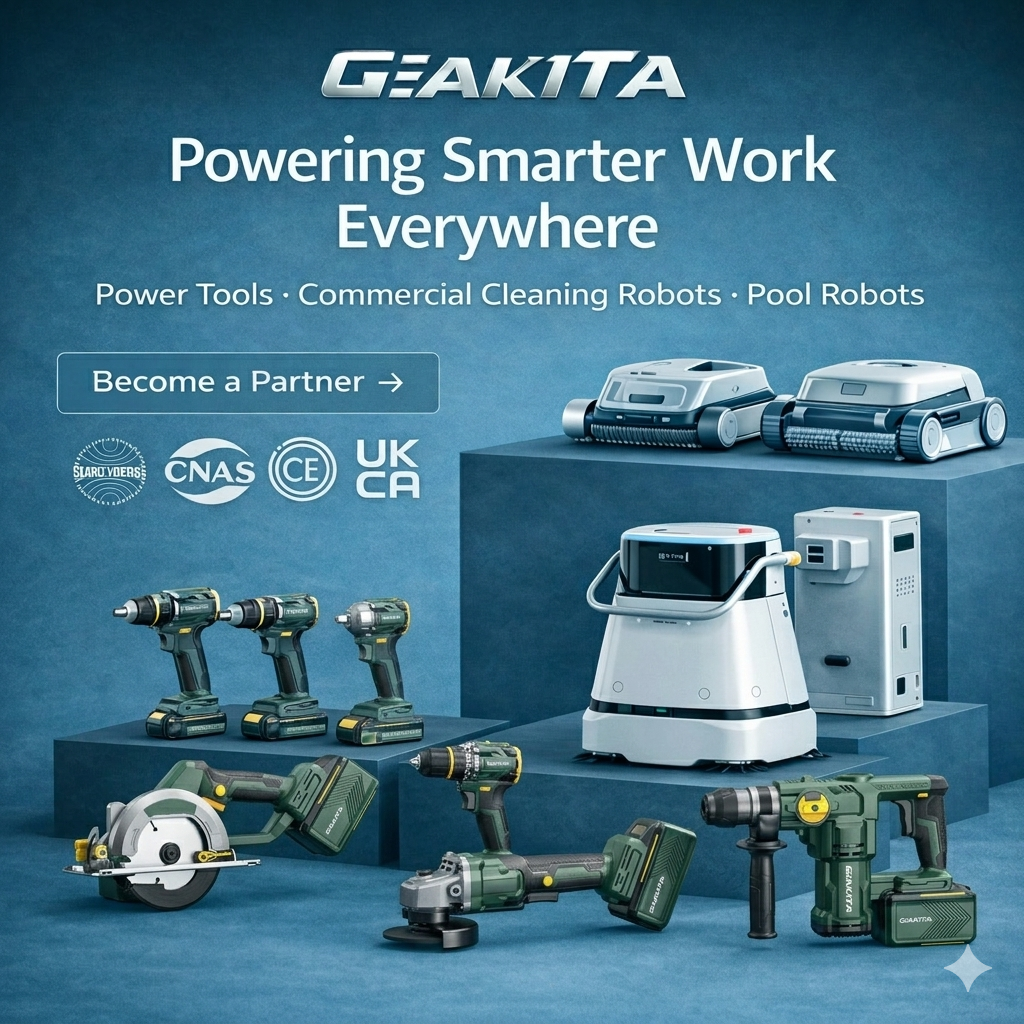
Geakita all-in-one OEM capability: robots, power tools and the supporting equipment categories discussed in this guide are supplied within one manufacturing framework.
Next step: confirm your accessory scope before the order
Geakita (Xiamen Tiangong Kaiwu Technology Co., Ltd.) manufactures commercial cleaning robots and power tools, and can quote robots, batteries and chargers, tool accessories, storage cases and dust extraction systems as one line-item scope. Send your draft accessory list for a model-level confirmation, or download the catalogue first.
Download the Geakita Corporate Profile & Product Catalog (PDF) · www.geakita.com
Contact: Flora · Email: Flora@gearpioneer.com · Tel / WhatsApp: +86 135-9954-5996
Address: 9-3, Room 203, No. 30 Guanri Road, Software Park, Phase II, Torch High-tech Zone, Xiamen, Fujian, China