- Industry News
- 548
- Gearpioneer-Powering Smart Work EveryWhere
- 12/11/2026
Head-to-Head Decision: Cordless Drill vs Rotary Hammer
Compare a 16.8V cordless drill and a 21V rotary hammer on documented capacity, torque settings, battery families and duty mode before you source.
Head-to-Head Decision: Cordless Drill vs Rotary Hammer
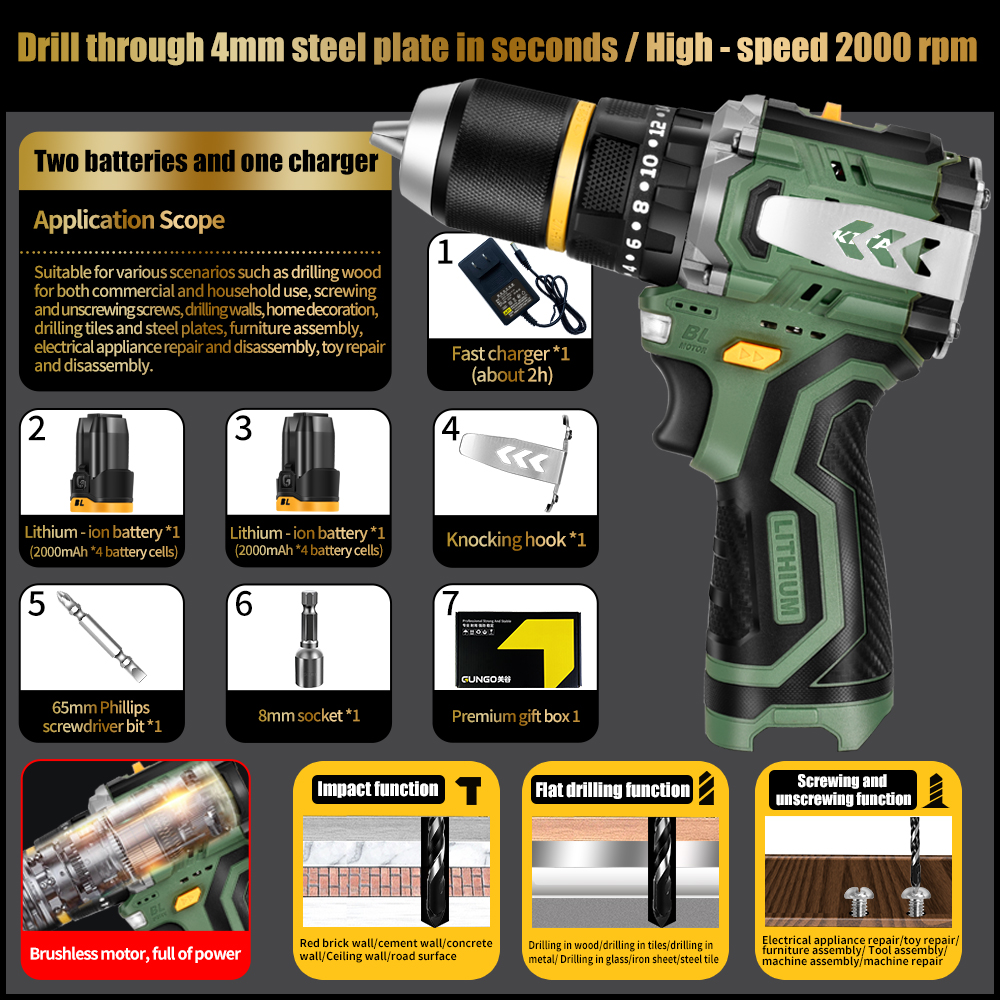
Geakita DK02, the 16.8V brushless impact drill compared in this guide.
A cordless drill and a cordless rotary hammer are separated by the hole they are asked to make, not by brand preference. In Geakita's published specifications, the 16.8V DK02 brushless impact drill lists drilling capacity of 13 mm in steel and 50 mm in wood with no concrete figure, while the 21V RH01 and RH02 rotary hammers list 26 mm in concrete, 13 mm in steel and 26 mm in wood. Concrete anchor work points to the rotary hammer. Fastening, assembly and steel-and-wood drilling point to the drill's 24+3 torque settings and two speed ranges.
Geakita (Xiamen Tiangong Kaiwu Technology Co., Ltd.) is a China-based manufacturer of cordless power tools, robotic pool cleaners and commercial cleaning robots, founded in 2009. Its cordless range also covers impact wrenches, angle grinders, circular saws and battery car washers. That breadth matters here because the drill-versus-hammer question is asked inside a kit decision: a distributor, contractor or maintenance workshop is not choosing one tool in isolation, but deciding which capability a project or starter assortment cannot run without.
What this head-to-head actually decides
Three inputs settle the choice, and each can be checked from a specification sheet before a sample is requested.
Base material and maximum hole diameter come first. The two sheets overlap on steel at 13 mm, so steel drilling up to that size does not by itself justify the rotary hammer. The divergence is concrete: 26 mm is documented for RH01 and RH02, while the DK02 sheet lists no concrete capacity. Wood reverses the picture, at 50 mm for the drill against 26 mm for the hammer.
Operation mix comes second. The DK02 sheet lists 24 torque settings plus three functions and two speed ranges, 0–450 and 0–2,000 r/min, which makes it the more granular fastening reference of the two. The rotary hammer sheet lists a single 0–2,000 r/min range and no torque value, so controlled screwdriving is not its documented purpose.
Duty mode comes third. Geakita's application data describes cordless tools in continuous operation of 8–12 hours a day, in intermittent DIY and household use, and in portable on-demand use, and positions the range for industrial production lines, construction sites, household maintenance and heavy-duty continuous operation. Duty mode changes the pack and charger plan more than it changes the tool head.
Where the cordless power tools category stands in 2026
Grand View Research values the global cordless power tools market at USD 15.7 billion in 2026, up from USD 14.4 billion in 2025, and forecasts growth to 2033. Category totals are not strictly comparable between publishers because inclusion rules differ — whether garden equipment and robotic cleaners are counted changes the number — so the figure is useful as scale, not as a supplier benchmark.
For a buyer, the more relevant structure is the battery system. A cordless range is a pack-and-charger platform before it is a list of tools. Geakita's Elite series is listed as 21V brushless with 1,300–2,000 mAh × 10-cell packs across drills, impact screwdrivers, angle grinders, rotary hammers and 650 N·m and 1,000 N·m impact wrenches. The DK02 drill runs a smaller 16.8V, 4 × 1,500 mAh pack. Choosing between the drill and the hammer therefore also decides which battery family a project standardizes on, how many spare packs it carries and how many chargers sit in the crib.
Option A: the 16.8V brushless impact drill (DK02)
The DK02 is documented as a 16.8V brushless impact drill with a pure-copper brushless motor, a 13 mm chuck, 24 torque gears plus three functions, no-load torque of 0–120 N·m, a low range of 0–450 r/min and a high range of 0–2,000 r/min, and impact frequency of 7,000 times per minute in low gear and 24,000 times per minute in high gear. Drilling capacity is listed as 13 mm in steel and 50 mm in wood.
Three details change how the tool gets specified. The 24+3 setting count lets fastening torque be dialled to the material instead of controlled by trigger pressure alone. The two speed ranges separate hole-making from driving, so a 50 mm wood hole and a repeated screw run do not share the same gear. And the 50 mm wood figure is the larger of the two wood capacities in this comparison, which matters on framing, decking and carpentry work where wood holes set the pace.
The boundary is concrete. The sheet lists no masonry or concrete capacity, and an impact drill's percussive action is a different mechanism from a rotary hammer's hammer action. Concrete work should be specified from the hammer sheet rather than assumed from the drill's impact function.
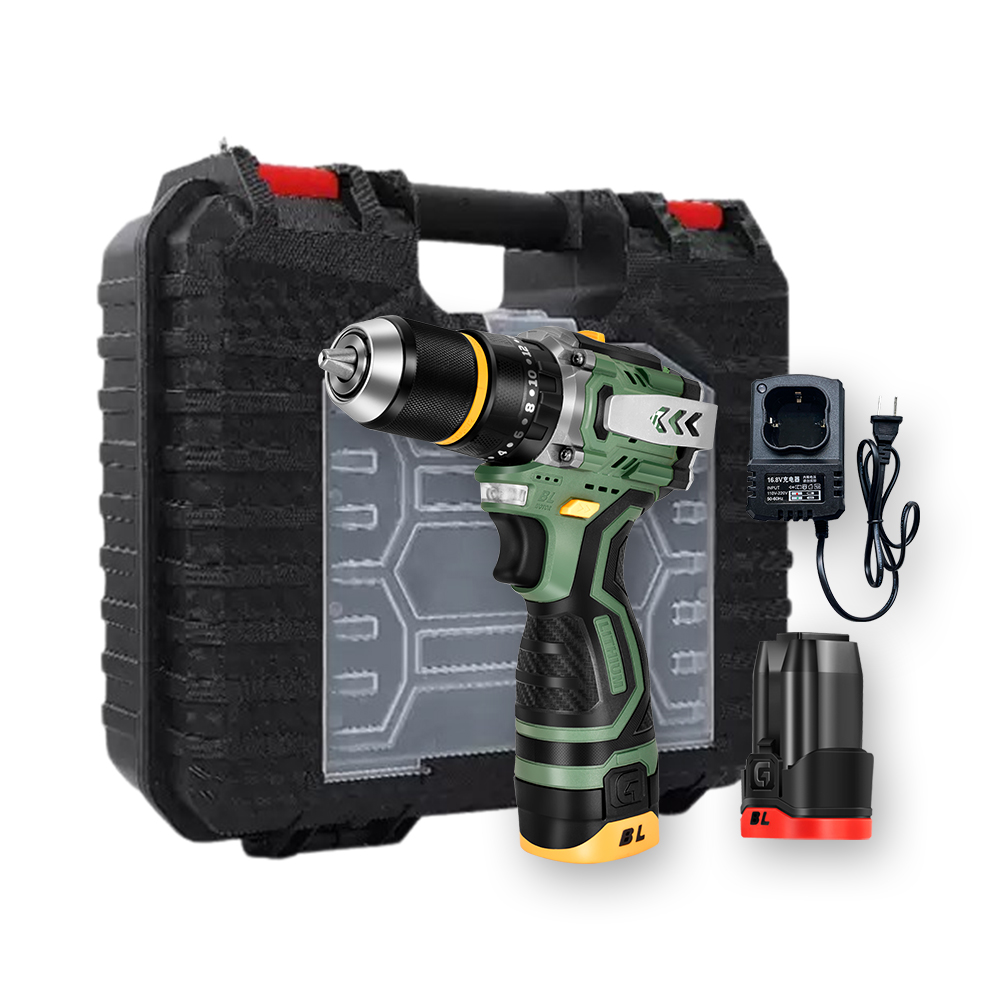
DK02 body view; the sheet lists a 13 mm chuck and 24+3 torque settings.
Option B: the 21V cordless rotary hammer (RH01 and RH02)
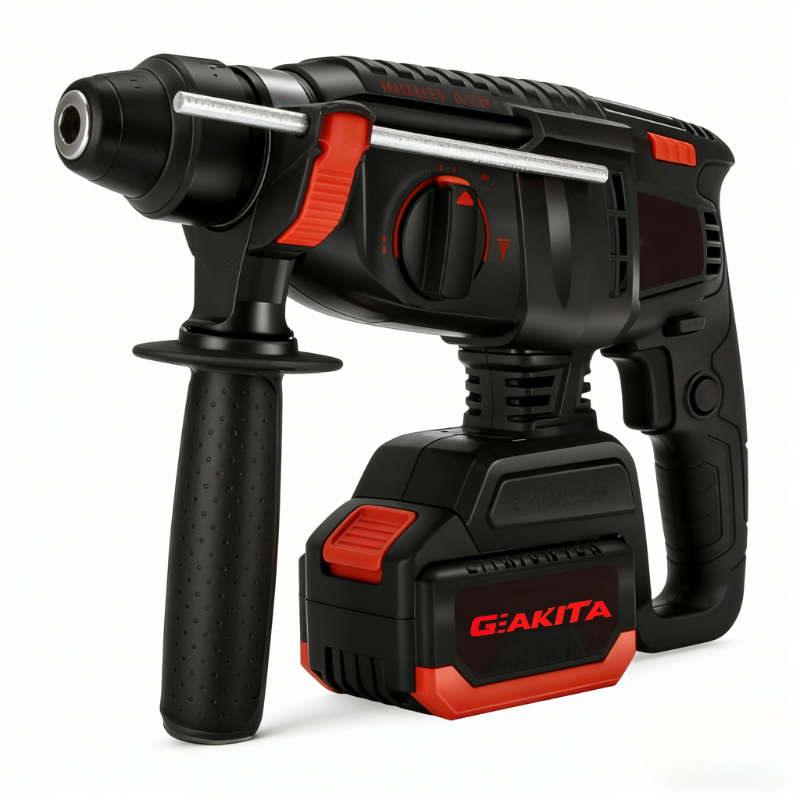
Geakita 21V cordless rotary hammer RH-01; RH02 is listed with the same parameters.
RH01 and RH02 are listed with the same parameters: 21V, pure-copper brushless motor, 2,000 mAh × 10-cell battery, no-load speed 0–2,000 r/min, a docking charger, and drilling capacity of 26 mm in concrete, 13 mm in steel and 26 mm in wood.
Because the two model sheets match, the choice inside the family turns on commercial terms — availability, kit content, packaging — rather than on documented capacity, and that difference should be confirmed in writing rather than assumed. What the sheet does establish is concrete capability: 26 mm is the only concrete figure in this comparison. The 2,000 mAh, 10-cell pack is also the larger pack here, which matters where shifts run long and charging turns are planned. The sheet does not list a torque value, a torque-setting count or a bit-interface standard, so those items belong on the question list rather than in the specification.
Side-by-side: the documented specifications
| Criterion | DK02 — 16.8V brushless impact drill | RH01 / RH02 — 21V cordless rotary hammer |
|---|---|---|
| Rated voltage | 16.8V | 21V |
| Motor | Brushless, pure copper | Brushless, pure copper |
| Battery as listed | 1,500 mAh × 4 cells | 2,000 mAh × 10 cells |
| Stated torque | 0–120 N·m, listed as no-load torque | Not listed |
| No-load speed | 0–450 r/min low, 0–2,000 r/min high | 0–2,000 r/min |
| Impact frequency | 7,000 min⁻¹ low, 24,000 min⁻¹ high | Not listed |
| Torque settings | 24 gears + three functions | Not listed |
| Chuck / bit interface | 13 mm chuck | Bit interface not listed |
| Concrete capacity | Not listed | Φ26 mm |
| Steel capacity | 13 mm | Φ13 mm |
| Wood capacity | 50 mm | Φ26 mm |
| Charger | Not listed on sheet | Docking charger |
Source: Geakita published specifications for DK02, RH01 and RH02. “Not listed” means the supplied sheet does not state the value; it does not mean the tool lacks the capability.
Step-by-step: running the decision in five steps
- Fix the material and the largest hole. If concrete is in scope, start from the rotary hammer sheet, where 26 mm is documented; the drill sheet carries no concrete figure. If the work is steel to 13 mm or wood to 50 mm, the drill sheet already covers the range.
- Map duty mode to packs rather than to tools. Continuous operation of 8–12 hours a day, intermittent household use and portable on-demand work are all listed modes for the range. Long shifts argue for the 2,000 mAh, 10-cell pack and a planned charging rotation; short intermittent work argues for the lighter 4-cell pack.
- Choose the battery family deliberately. Geakita supplies 16.8V and 21V battery families with chargers and matched kit configurations. Cross-model interchangeability is not stated in the supplied materials, so compatibility should be confirmed per SKU before a kit is standardized.
- Check the interface and the accessories. The DK02 uses a 13 mm chuck. Batteries and chargers, drill bits, screwdriver bits, grinding wheels, cutting discs, sockets and carrying cases are listed as matched equipment in the application data, and dust extraction is listed for cutting and grinding work. For the rotary hammer, request the bit interface in writing, since the sheet does not state it.
- Close the paperwork before production. Ask for model-level test documents, the inspection plan, the MOQ structure and the production schedule with the quotation, so tool, pack and accessory lines are sequenced as one order rather than three.
Duty mode and site conditions: what the sheets do not say
Geakita's application data states that the tools are designed for industrial production line, construction site, household DIY maintenance and heavy-duty continuous operation environments, and that they operate in continuous (8–12 hours a day), intermittent and portable on-demand modes. The same data lists ergonomic design for long holding and low vibration and noise for workshop safety as requirements. Those are requirement statements, not measured values.
The supplied specifications do not state runtime per charge, charge time, vibration or noise figures, or service life for the DK02 or the RH01/RH02. Where a shift plan depends on those numbers, they should be requested as test data rather than inferred from battery capacity: a 10-cell pack carries more cells than a 4-cell pack, but cell count alone does not produce a runtime figure for a specific task.
Use cases: which option leads
- Concrete anchors, railings, pipe supports and façade fixing: the rotary hammer, on the documented 26 mm concrete capacity.
- Assembly, furniture, electrical installation, steel fabrication to 13 mm and woodwork to 50 mm: the DK02, whose torque settings and two speed ranges are documented for driving and drilling.
- Mixed-service workshop or distributor starter assortment: both, split by task, with a dedicated fastening tool. The Elite series lists QZ03 and QZ05 impact screwdrivers alongside the drills, grinders and wrenches, which keeps fastening work off the drilling tools.
- High-temperature sites: Geakita reports a case covering more than 5,000 units over two years or more, with 99.8% on-time delivery, a 0.3% defect rate and stable performance in 45 °C+ conditions. These are company-reported results for that programme; they describe the supplier's record in that project rather than a guarantee for a different one, and should be read with the inspection terms for your own order.
Where this decision goes wrong
“Not listed” is read as “not capable”. The DK02 sheet has no concrete figure and the hammer sheet has no torque value. Neither absence proves a limitation; both mean the item has to be confirmed in writing before procurement relies on it.
Torque numbers are compared across different labels. The 21V PT20 brushless impact drill lists an actual torque of 80 N·m, the PT12 lists 60 N·m with a 5-cell pack, and the DK02 lists a no-load torque of 0–120 N·m. “Actual torque” and “no-load torque” are different labels, and the supplied sheets state no common measurement method, so these values should not be ranked against each other.
Battery compatibility is assumed. The 16.8V and 21V families are listed separately with their own chargers and kit configurations, and no interchangeability statement is given. A kit planned around mixed voltages needs that confirmed before the order, not after.
One tool is expected to cover both jobs. A rotary hammer is documented for concrete; it is not documented as a precision fastening tool. A drill with an impact function is not documented for concrete. Splitting the two tasks keeps each tool inside its documented range; asking one tool to do both means specifying outside at least one of the two sheets.
Procurement checks before you commit
Several of the checks below apply to either tool, and they are worth closing before a first order is released.
- Quality control: 100% full inspection before shipment, three-level QC covering IQC, IPQC and FQC, functional and load testing, and production and warehouse records that support traceability. Engineering covers motors, transmissions, electronic controls, battery management and reliability, and quality control combines incoming-material checks, production inspections and final testing with electrical, torque, durability and environmental tests.
- Compliance documents: the application data for the markets it covers lists CE, UL, INMETRO and FCC as requirements, plus IP rating where the application calls for it, and documentation and inspection requirements are coordinated for each model and destination market. Third-party inspection by SGS or TÜV and on-site factory acceptance can be arranged on request, according to company materials.
- Order structure: the documented minimum is at least five categories of power tools, eight items per category, 40 items in total. Mass production runs 30–45 days; repeat orders run 20–28 days, with shipping calculated separately by method and destination port.
- After-sales: a global warranty, 7×24 technical support, on-time replacement for defective units and spare-parts supply.
- Customization: logo printing, packaging design, voltage options for 110V and 220V, parameter adjustment for torque and speed, colour scheme, and battery configuration between 2.0Ah and 4.0Ah.
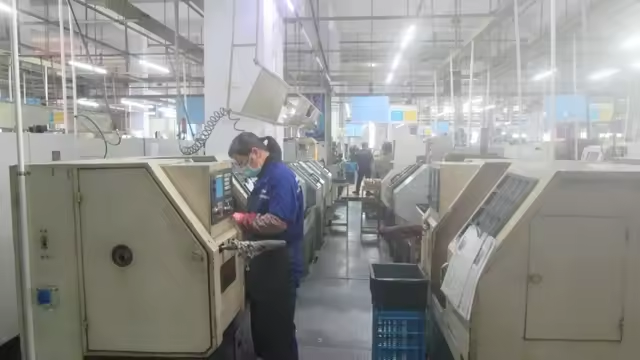
Quality control combines incoming-material checks, production inspections and final testing, supported by electrical, torque, durability and environmental tests.
FAQ
What certification documents should I request with a cordless drill or rotary hammer order?
Request the model-specific declaration and test evidence for the destination market, not just a certificate for the factory. In the markets covered by Geakita's application data, CE, UL, INMETRO and FCC are listed as requirements, with IP rating where the application calls for it. Geakita states that documentation and inspection requirements are coordinated per model and destination, and that third-party inspection by SGS or TÜV and on-site factory acceptance can be arranged on request. Check certificate scope against the exact model you are buying before releasing production.
Do the DK02 drill and the RH01/RH02 rotary hammer share a battery?
The published sheets place them in different families. The DK02 uses a 16.8V, 4 × 1,500 mAh pack; RH01 and RH02 use a 21V, 2,000 mAh × 10-cell pack. Geakita supplies 16.8V and 21V battery families with chargers and matched kit configurations, but the supplied materials do not state cross-model interchangeability. Confirm pack and charger compatibility per SKU before standardizing a kit, especially if the project mixes both tools.
Which of the two costs less to own?
The supplied materials publish no prices, so the cost difference has to come from a quotation. The documented cost drivers are battery configuration, with 2.0Ah and 4.0Ah options listed as customizable, kit content, and customization scope covering logo, packaging, colour, voltage and torque or speed parameters. Because the minimum order is structured as at least five categories of eight items, 40 items in total, the mix rather than the single tool usually sets the order value.
Can we validate a sample before placing a production order?
The supplied materials do not publish a sample policy. What is documented is the inspection regime — 100% full inspection before shipment, three-level QC and functional and load testing — and the minimum order structure of at least five categories, eight items per category, 40 items in total. Treat sample quantity, sample cost and sample lead time as terms to confirm in writing alongside that minimum, and specify which model and pack configuration the sample must represent.
What lead time should we plan for?
Mass production runs 30–45 days and repeat orders run 20–28 days, with shipping time calculated separately by method and destination port. Plan the first order around the longer window and ask for a production schedule with the quotation, so tool, pack and accessory lines are sequenced together. If the site date is fixed, get that schedule in writing before confirming the mix.
Conclusion
The head-to-head ends where it started: the hole decides. Where concrete is in scope, the RH01 and RH02 sheets carry the only documented concrete capacity in this comparison, at 26 mm. Where the work is fastening, assembly, steel to 13 mm and wood to 50 mm, the DK02's 24+3 settings and two speed ranges are the documented fit. For a workshop or a distributor assortment, carrying both keeps each tool inside its own sheet, and the 16.8V versus 21V question becomes a pack-and-charger decision rather than a tool decision.
Before committing, test the sample against your own material and shift pattern, confirm the bit interface and battery compatibility for the exact SKU, and match the certificate scope to the model and destination market.
Next step: request a sample and a quotation against your actual mix, or review the full range, battery families and OEM options in the GEAKITA Corporate Profile & Product Catalog 2026 (PDF).
Geakita (Xiamen Tiangong Kaiwu Technology Co., Ltd.) · www.geakita.com · flora@gearpioneer.com · +86 135 9954 5996 (phone/WhatsApp)